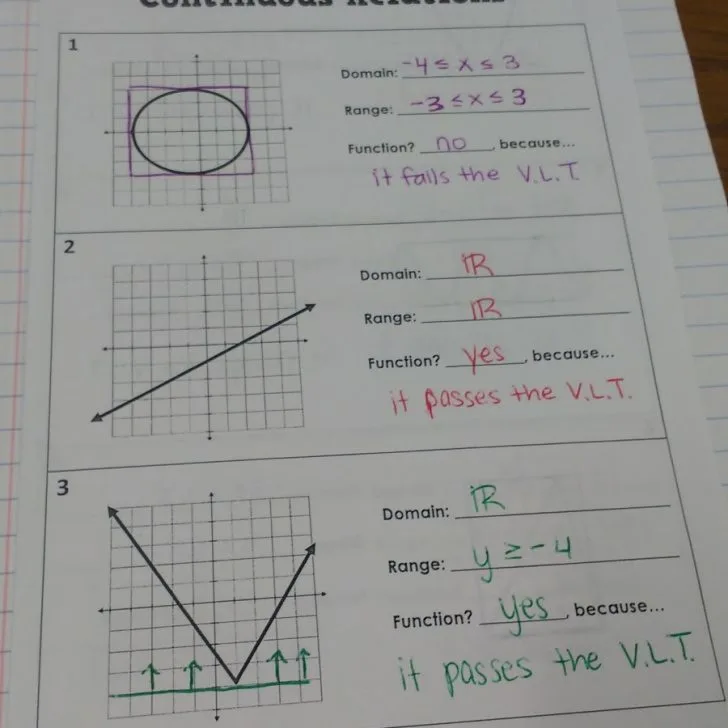
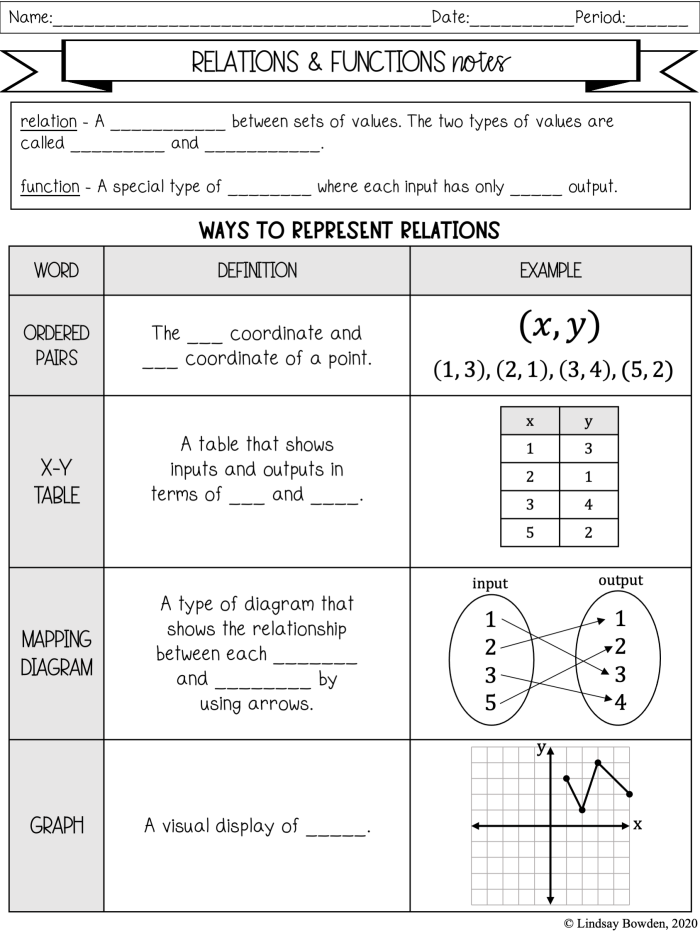
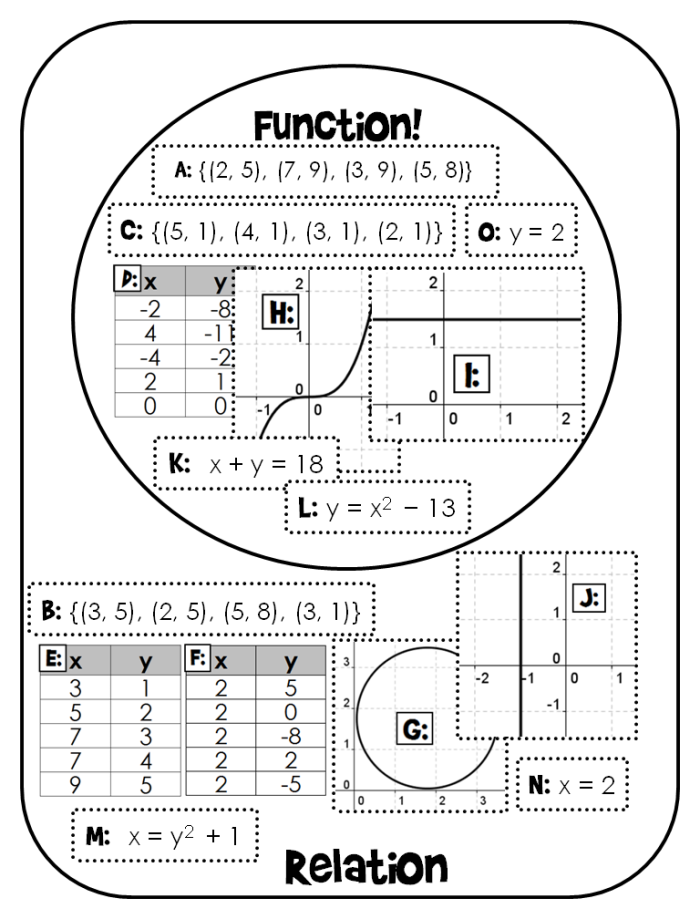
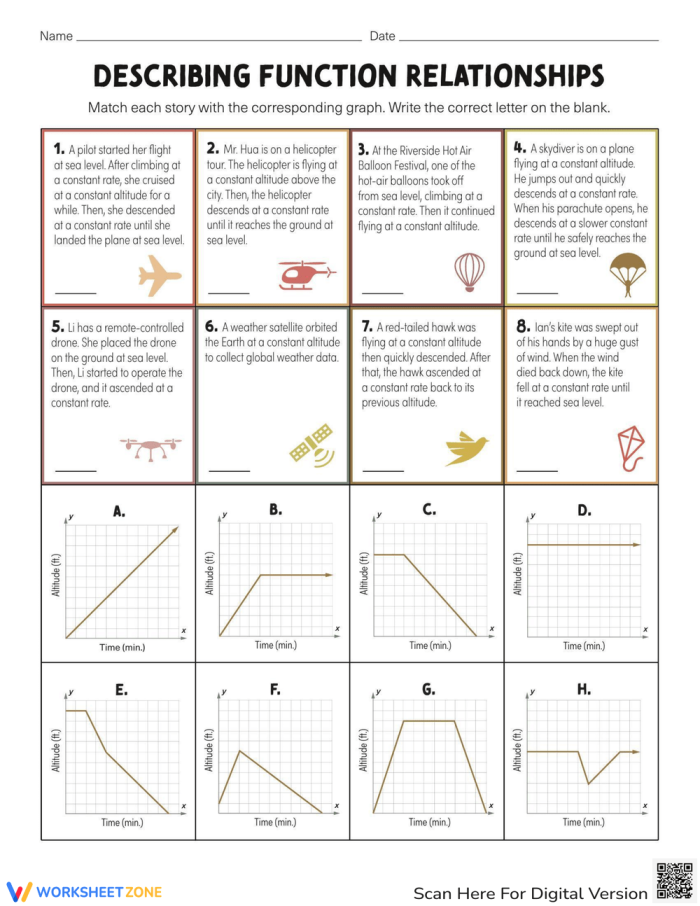
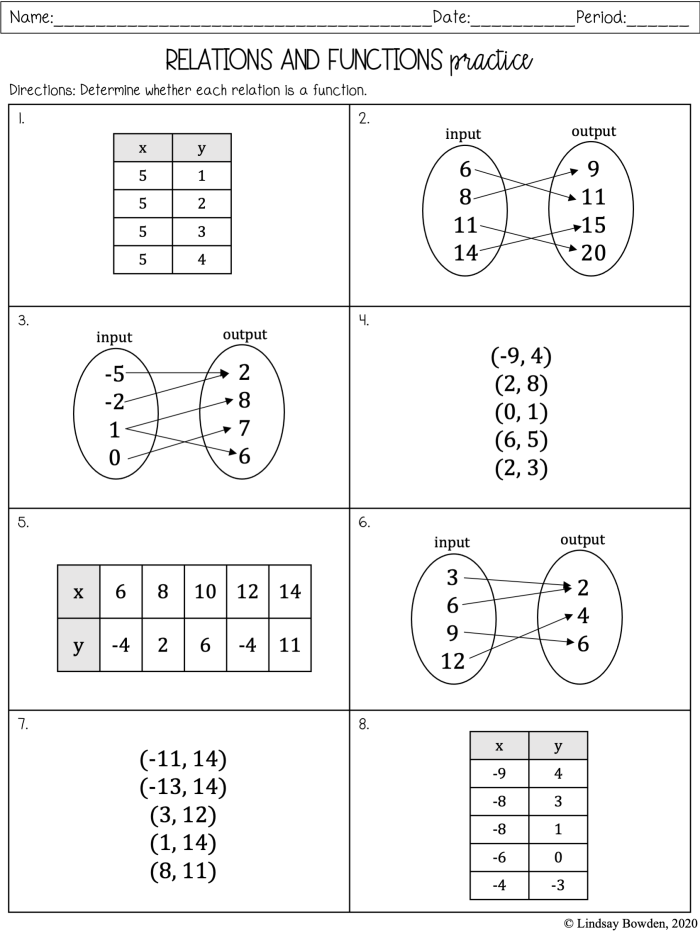
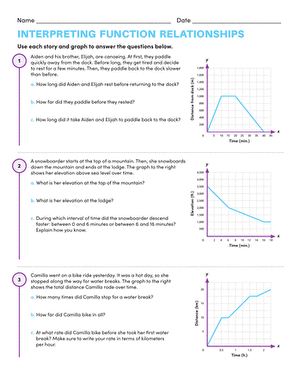
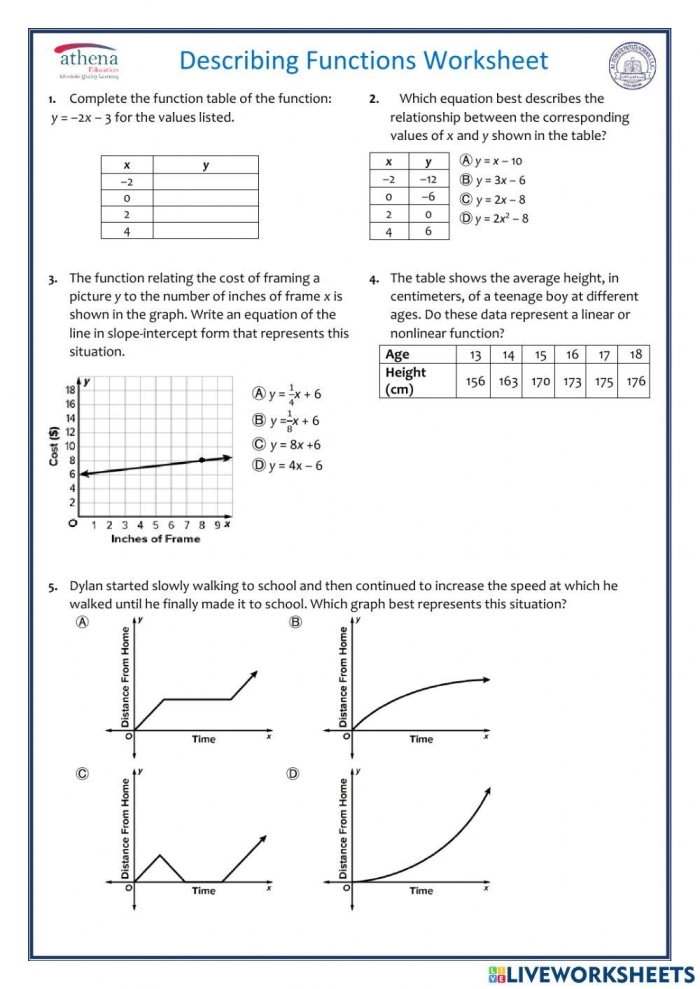
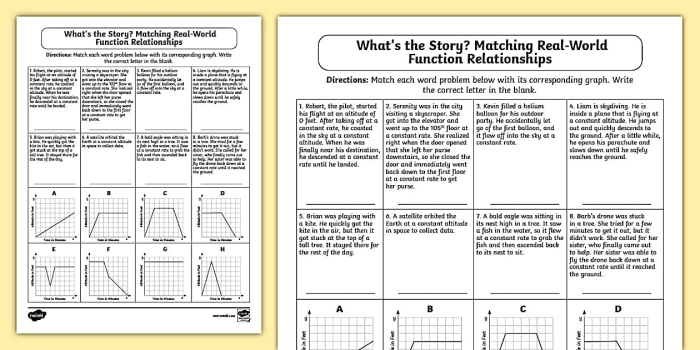
Matching word problems to their corresponding graphs forces students to think about what functions actually represent in the real world. This eighth-grade algebra worksheet takes that concept further by requiring students to connect narrative descriptions directly to visual representations on a coordinate plane.
The beauty of this approach lies in how it bridges the gap between abstract mathematics and concrete scenarios. When an eighth grader reads a story about a car traveling at a constant speed, then has to find the graph that shows that relationship, they’re building genuine understanding rather than just memorizing procedures. The stories might involve situations like a bathtub filling with water, a phone battery draining over time, or money accumulating in a savings account. Each narrative tells a different story about how one quantity changes in relation to another.
Working with decimals adds another layer of complexity that’s appropriate for this grade level. Instead of whole numbers on the axes, students encounter values like 2.5, 3.7, or 0.8. This forces them to read graphs more carefully and think about precision. A student can’t just estimate where a point falls, they need to understand decimal placement and what each marking on the axis represents.
The matching format itself serves a pedagogical purpose. Rather than asking students to create graphs from scratch, which can feel overwhelming, matching lets them focus on interpretation. They’re analyzing what each graph shows: Is it increasing or decreasing? Is the rate of change constant or changing? Does the story match what the graph displays?
Teachers find this structure particularly useful because it allows for differentiation. Some students might need to work through the stories slowly while others move quickly to the matching portion. The worksheet also creates natural opportunities for discussion when students disagree about which story matches which graph. Those conversations often reveal exactly where misconceptions exist, making this tool valuable for formative assessment.
For practice materials that develop describing function relationships with decimals in eighth-grade algebra, this matching approach consistently produces better retention than traditional problem sets.
Hands-On Worksheet Activities