Most seventh graders have never seen the Milky Way. That’s not because it disappeared, but because artificial light has drowned it out. Light pollution has transformed our night skies so dramatically that roughly one-third of humanity cannot see the Milky Way from where they live.
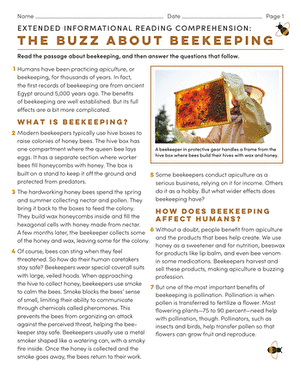
This three-page reading comprehension worksheet tackles the problem head-on through an enlightening passage that explains what light pollution is, how it developed, and what we can actually do to restore our dark skies. The material works well for seventh grade students developing their informational reading skills, especially those building sight words vocabulary through contextual learning.
The passage walks readers through concrete examples of how unnecessary outdoor lighting wastes energy and disrupts ecosystems. Street lamps, billboards, and building facades that stay lit all night create a constant glow that affects migratory birds, disrupts sleep cycles in animals, and makes stargazing nearly impossible in urban areas. Students learn that the problem has a relatively short history, with most light pollution occurring only in the last 50 to 70 years.
What makes this worksheet valuable is its focus on solutions rather than just problems. Readers discover practical steps: using motion-sensor lights, choosing warm-colored bulbs that don’t scatter as much light, and advocating for communities to adopt dark-sky ordinances. Some cities have already implemented these changes with measurable success. Tucson, Arizona, for instance, has protected certain areas specifically to preserve night sky visibility.
Working through this material helps students understand how environmental issues connect to everyday choices. They practice extracting main ideas and supporting details from informational text, skills essential for academic success. The worksheet also reinforces sight words through repeated exposure in meaningful context rather than isolated lists.
For educators looking to connect reading comprehension with environmental awareness, this resource offers substantive content. Students who complete this exercise often become more conscious of their own communities’ lighting habits and understand why some people advocate for darker nights.
If your seventh graders need additional comprehension practice, consider pairing this with other informational reading comprehension materials that explore natural phenomena. You might also integrate mathematical concepts by having students calculate the area of circles as they learn about how light spreads in circular patterns from street lamps.
Use These Worksheets Today